How Random Forest works? – It’s a forest of Trees!!
1. Simply, its a combination of many trees.
2. It’s always better to take more suggestions and decide on majority voting rather going for a single suggestion. Same principle works in our Random Forest.
3. In this way, the probability of error gets decreased.
4. So, it works similar to the decision tree.
5. The number of trees is the main parameter and remaining all similar to the decision tree.
How to know the optimal parameters where model performance is high?
1. Here comes the hyper-parameter tuning for increasing model performance.
2. There are two types of hyper-parameter tuning. i) Grid search and ii) Randomized search.
3. For both types, we have to give the ranges of parameters and algorithm searches in those ranges and gives us the optimal parameters.
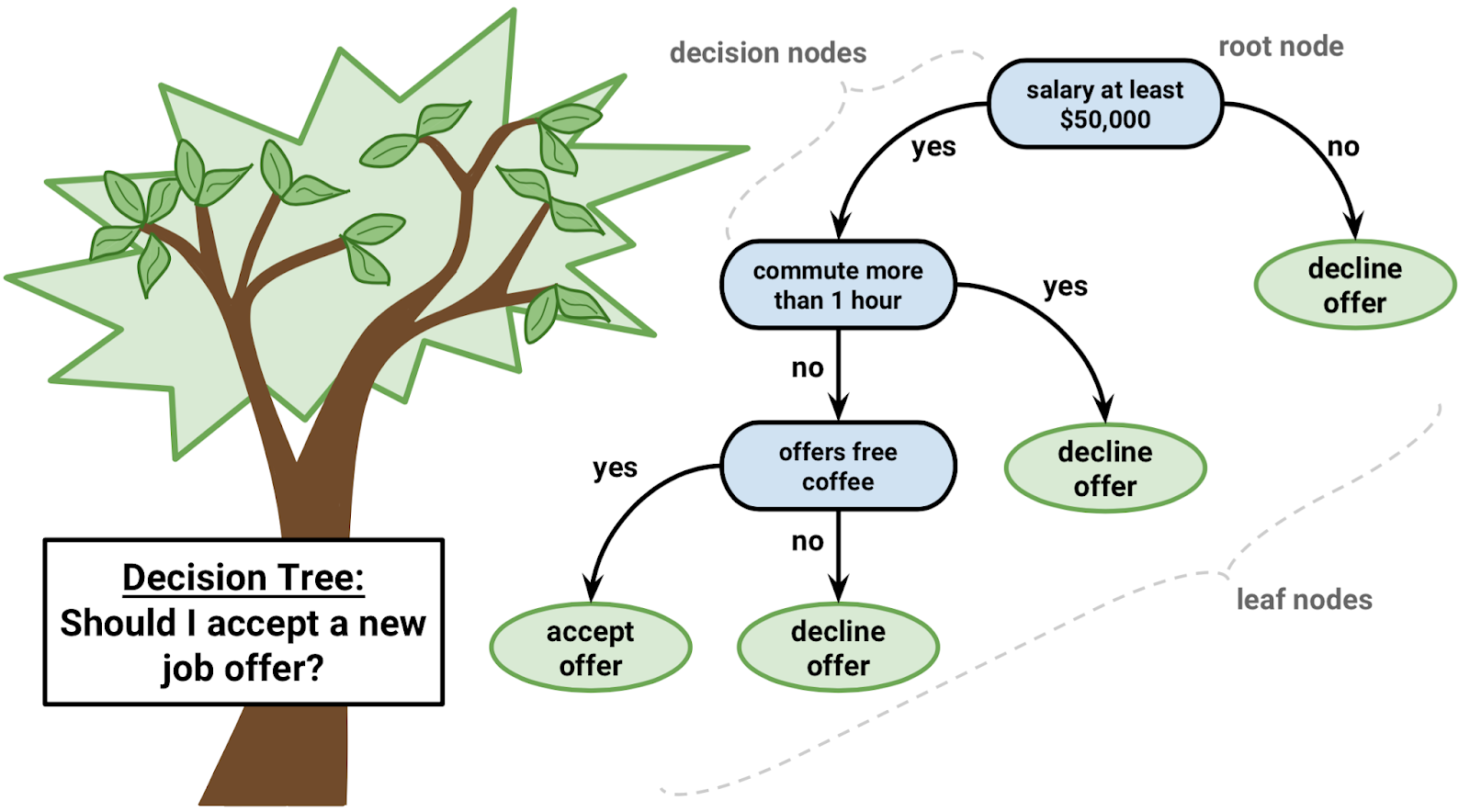
1. A simple IF-THEN rules through the branches of a tree till the leaf which tells us the output and why it is.
2. It splits the features into the branches and goes till leaves.
3. So, the parameters for a decision tree will be maximum depth of tree, minimum leaf size and the evaluation criterion.
4. How to evaluate a leaf? We always see for a homogeneous leaf.
5. What is homogeneous? Let’s have 2 leafs L1 and L2. L1 have 50 values Yes and 50 Values No.L2 have 90 vales Yes and 10 values No. Which one we will prefer? It’s obvious to prefer L2. So L2 is a homogeneous leaf which gives more information.
6. So, the evaluation criterion is based on how much information we gaining.
7. Because of this information gain, the decision tree always try to overfit the model.
8. So how to stop our tree for not getting overfit?
9. Here comes the pruning. Pruning is cutting down the tree based on information gain.
10. If there is no much information gain from one level to next level of the tree, there is no use of expanding our tree.
Problem: The land is one of the main natural resource available. There is a huge potential in reaping the benefits out of it. In contrast, 2017 GDP report says Agriculture sector contributes only 6.4 percent of the total world’s economic production. Lack of proper irrigation facilities in many underdeveloped and developing countries is affecting the agriculture sector at a greater extent. Which is mainly due to low rainfall and unavailability of electricity.
Solution: To tap the potential from this untapped area, Microsoft’s AI & IoT Insider Labs is helping “SunCulture”. By combining solar power and precision irrigation, SunCulture’s RainMaker2 pump is making cost-effective for farmers in yielding more returns.
Description: This device collects the sensor data, like soil moisture, pump efficiency, solar battery storage, and other factors using a cloud environment. Due to presence of SunCulture’s network in almost 2,000 locations, they are combining all the data from sensors and using machine learning tools in providing effective irrigation recommendations to farmers through mobile SMS which is helping them in taking efficient irrigation decisions.
Machine learning is everywhere throughout the whole growing and harvesting cycle. It begins with a seed being planted in the soil – from the soil preparation, seeds breeding and water feed measurement – and it ends when robots pick up the harvest determining the rightness with the help of computer vision.
Extension: This can be extended by analyzing more variables like land area, yield, leaf vein morphology, crop quality characteristics, pesticides data, weeds data, material stocks and using appropriate machine learning tools, we can be able to predict the things like,
1. Which genes will most likely contribute a beneficial trait to a plant,
2. Expected weather phenomena and estimate evapotranspiration and evaporation,
3. Yield Prediction,
4. Accurate detection and classification of crop quality which can decide price,
5. Pest & Disease Detection,
6. Weed Detection,
7. Effective and efficient livestock production systems.
With these predictions, the agriculture sector can increase the production levels and products quality.
Its on the eve of Pongal 2019, I decided to shift my career path to Analytics. Its a herculean task with many deadlines, lots of money involved, preoccupied with a 14 hours job. Finally its Arizona State University and Business Analytics. Success is a journey not a destination. My journey just begins.




 Four Knights Analytics